

Quick answer: Beta-glucans are naturally occurring polysaccharides found in the cell walls of mushrooms, yeast, oats, and barley. Research shows they bind to receptors on immune cells like macrophages and natural killer cells, helping the immune system recognize threats and respond more effectively. They’re one of the most studied compounds in functional mushrooms, including Apán.
Beta-glucans are a type of polysaccharide, meaning a long chain of sugar molecules, found in the cell walls of certain fungi, yeast, and cereal grains like oats and barley. In mushrooms specifically, beta-glucans (particularly the 1,3/1,6 linked forms) make up part of the structural cell wall and are considered one of the primary bioactive compounds responsible for functional mushrooms’ reputation in wellness circles.
They are not unique to any single mushroom. Reishi, chaga, turkey tail, lion’s mane, and Apán all contain beta-glucans, though the concentration and exact molecular structure vary by species, growing conditions, and how the mushroom is processed into a finished product.
Beta-glucans support immune function by binding to specific receptors on the surface of immune cells. According to research published in the peer-reviewed literature, beta-glucans are recognized by pattern-recognition receptors including Dectin-1, complement receptor 3 (CR3), and toll-like receptors 2 and 6, found on macrophages, neutrophils, monocytes, natural killer cells, and dendritic cells.
When beta-glucans bind to these receptors, they can help activate the cells responsible for the body’s first line of defense. A 2023 review in the journal Cells describes beta-glucans as a “biological response modifier” that promotes dendritic cell maturation, supports cytokine signaling, and helps regulate the broader immune response rather than acting on a single pathway. Some newer research also points to a phenomenon called trained immunity, where beta-glucan exposure appears to leave certain immune cells more prepared to respond the next time they encounter a threat.
This is why beta-glucans are typically described as immune-modulating rather than immune-stimulating. The goal is a well-regulated, responsive immune system, not simply “more” immune activity.
The three most common commercial sources are yeast (usually baker’s or brewer’s yeast), cereal grains (oats and barley), and mushrooms. Each source produces a structurally different beta-glucan, which matters more than most labels let on.
| Source | Common Linkage | Typical Use |
|---|---|---|
| Yeast | Beta-1,3/1,6-glucan | Standalone immune-support supplements |
| Oats and barley | Beta-1,3/1,4-glucan | Heart-health and cholesterol-support products, whole foods |
| Mushrooms (including Apán) | Beta-1,3/1,6-glucan (varies by species) | Functional mushroom extracts, alongside polysaccharides and other compounds |
Apán is wild-harvested rather than cultivated on a growing medium. It develops its compound profile in its native environment, which is part of why Live Nativ treats sourcing as a first-order decision rather than an afterthought. You can read more about that difference on the Wild Apán wild-harvested vs. cultivated page.
Yes, and this is one of the most overlooked variables in the mushroom supplement category. Raw mushroom powder alone is difficult for the body to break down because beta-glucans are locked inside a tough cell wall (chitin). Most reputable mushroom extracts use hot water extraction, alcohol extraction, or a dual extraction combining both, specifically to release beta-glucans and other water- and alcohol-soluble compounds from the cell wall.
A supplement that lists “mushroom powder” with no extraction method or standardization is not automatically equivalent to one that specifies an extract ratio. This is a genuinely useful thing to check on a label before buying any mushroom product, Live Nativ’s included.
The laboratory and mechanistic research on beta-glucans and immune receptors is well established and extensively published. Where the science is still developing is in large, long-term human clinical trials connecting beta-glucan supplementation to specific health outcomes. The NIH’s National Center for Complementary and Integrative Health notes that while many supplements are marketed for immune support, rigorous human evidence for a specific benefit doesn’t yet exist for every ingredient, and encourages consumers to approach immune supplement claims with a critical eye.
Apán naturally contains beta-glucans and polysaccharides. Live Nativ focuses on these naturally occurring compounds as part of Apán’s role in supporting healthy immune function and the body’s natural defenses.
Whole oats, barley, and mushrooms (cooked, since raw mushroom cell walls are hard to digest) all provide some dietary beta-glucan. For a more concentrated and consistent daily amount, a standardized extract is generally more practical than trying to eat your way to a specific dose.
Apán+ Max Daily is Live Nativ’s wild-harvested liquid extract, concentrating naturally occurring beta-glucans and polysaccharides into three dosing tiers: Daily Wellness (4 droppers per day, about 4 mL), Enhanced Support (8 droppers per day, about 8 mL), and Deep Healing (12 droppers per day, about 12 mL). Our dosage guide walks through how to choose a starting point. For a complementary botanical layer alongside beta-glucan support, Herbal Immune Power is worth a look.
Are beta-glucans the same in every mushroom supplement?
No. Concentration and molecular structure vary by mushroom species, growing method, and extraction process. A product’s extraction method matters as much as which mushroom is listed on the label.
Do beta-glucans cure or prevent illness?
No. Beta-glucans are studied for supporting healthy immune function, not for treating, curing, or preventing any disease.
Is mushroom powder the same as a mushroom extract?
Not necessarily. Raw powder can be harder for the body to access beta-glucans from due to the mushroom’s tough cell wall. Water or alcohol extraction is typically used to release those compounds.
Can beta-glucans be taken alongside other supplements?
Generally yes. As with any supplement, check with a healthcare provider, especially if you take medication or manage a health condition.
By the team at LiveNativ. Sources: Beta-glucan recognition by the innate immune system, Journal of Innate Immunity (PubMed); Immunomodulatory Effect and Biological Significance of Beta-Glucans, Cells (PMC, NIH); Using Dietary Supplements Wisely, NCCIH.
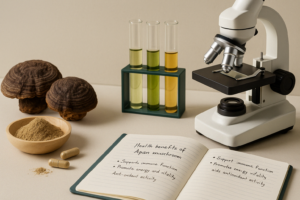
Apan mushrooms are gaining recognition for their powerful health benefits—but what does the science actually say? At LiveNativ,...
It’s a common belief that probiotics must be kept in the refrigerator to stay effective. But is that...
Put the research into practice
Our wild-harvested Apán+ Max Daily and Herbal Immune Power put these botanicals to work — high-potency liquid extracts, ethically sourced.
Shop LiveNativDISCLAIMER: Any statements have not been evaluated by the Food & Drug Administration. This product is not intended to diagnose, treat, cure, or prevent any diseases.